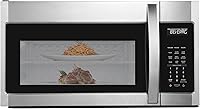
Over-the-Range Microwaves: The Complete Buying Guide
An over-the-range microwave mounts above the cooktop, heats your food and vents cooking smoke, so it replaces a range hood and frees counter space. Start with the cabinet fit, then choose ducted or recirculating venting and the size and features you'll use each week.
On this page (14 sections)
- What an over-the-range microwave does
- Sizes: 24, 27 and 30 inches
- Measure the cabinet before you shop
- Ducted or recirculating venting
- Low profile and standard heights
- Convection, air fry and combo models
- Brands and models: GE, Samsung, Frigidaire and more
- Replacing an old over-the-range microwave
- Parts you may need: filters, brackets and filler kits
- How to choose: a buying checklist
- Common mistakes to avoid
- Keeping an over-the-range microwave in good shape
- Every guide on this site
- Your next step for an over-the-range microwave
An over-the-range microwave mounts above the cooktop, heats your food and vents cooking smoke. It replaces a range hood, so it saves counter space and does two jobs in one spot.
The category has more choices than it first seems. There are 24-inch and 30-inch sizes, ducted and recirculating venting, low profile and standard heights, and convection and air fry models, and each choice affects the fit, the venting and the install.
This guide covers the topic in order, starting with the cabinet, then the venting, then the type and the features. Every section links to a deeper guide, and the list at the end links to every one of them.
What an over-the-range microwave does
An over-the-range microwave is a microwave oven that sits above the range, in the space where a hood would normally go. It heats food the same way a countertop microwave does, and it adds a fan and a light over the cooktop.
That combination is why people buy them, since the unit clears steam and smoke and leaves the counter open. For a small kitchen, that trade is often worth it.
If you're weighing this type against a countertop model, our over-the-range vs countertop microwave comparison covers the trade-offs in more detail.
Sizes: 24, 27 and 30 inches
Most over-the-range microwaves are sized for a 30-inch range, which is the standard width in many kitchens. The picks in our 30-inch roundup all measure 29.9 inches wide, so they fill a standard opening with little side gap.
Narrower openings need a 24-inch model, and some kitchens have a wider cabinet that takes a 30-inch unit with side filler panels. The 24, 30 and 36 inch guide compares the widths side by side, so you can see which one matches your opening.
For the 30-inch picks with their depth and height, our 30-inch roundup lists each model with the measurements that matter most.
Measure the cabinet before you shop
Measure the cabinet opening before you look at any model. Width matters, but depth and height often decide the fit, since a unit that's too deep can clash with a cabinet door or handle.
Take three measurements: the width at the top, middle and bottom, the height from the cooktop to the cabinet bottom, and the depth from the wall to the front. Write them down and compare them with each model's dimensions.
Our dimensions guide explains each measurement and shows how to check the fit before you order. For the install steps that follow, the installation guide lists what to plan before the unit arrives.
Ducted or recirculating venting
Venting is the feature that decides how the unit handles smoke and steam. A ducted unit sends air outside through a duct, while a recirculating unit passes air through a charcoal filter and back into the room.
A ducted setup is the stronger choice for heavy cooking, since it moves the air out of the house. A recirculating setup works when a duct can't reach an outside wall, but the filter must be changed on schedule, or odors come back.
Our venting options guide explains each setup in detail. If you're not sure whether your kitchen needs a vent at all, read whether an over-the-range microwave needs to be vented.
For the fan itself, our best over-the-range microwaves for venting roundup compares the strongest models, and the ductless guide covers the recirculating setup in full.
Over-the-range microwave fan power in plain terms
Fan power is measured in CFM, or cubic feet per minute. Most models in our roundups move 300 CFM, and a few move 400 CFM or more.
The number matters less than the setup. A strong fan that's ducted poorly will underperform, while a modest fan with a clear duct path often does the job for everyday cooking.
Low profile and standard heights
A low profile model is about 10 to 11 inches tall, while a standard model is about 16 inches, and that difference decides which one fits a short cabinet gap.
Low profile units hold less inside, so the choice is a trade-off between fit and room. If your gap is short, a low profile model may be the only option, and if the gap is generous, a standard unit gives you more capacity.
Our best low profile over-the-range microwave roundup compares three of the shortest models, and the low profile vs regular guide helps you decide between the two types.
Convection, air fry and combo models
A convection over-the-range microwave adds a heating element and a fan, so it can bake, roast and broil. An air fry model adds a crisp mode that works well for snacks and reheated food.
Convection models cost more than a standard unit, so the question is how often you'd use the extra modes. If baking or crisping is a weekly habit, a convection model replaces a second appliance.
Our best convection over-the-range microwave roundup compares three convection picks, and the air fryer guide covers the one over-the-range model with an air fry mode. For the basic difference between the two types, the convection vs regular microwave guide walks through each one.
Brands and models: GE, Samsung, Frigidaire and more
GE is a common starting point, and it has over-the-range models from standard to low profile. Our best GE over-the-range microwaves roundup compares its models side by side.
Other brands compete on different features, such as Samsung's slim, connected low profile model with 550 CFM venting. Our GE vs Frigidaire comparison and GE vs Samsung comparison show how the brands differ in practice.
If you're deciding on the type rather than the brand, our over-the-range vs built-in microwave comparison explains when a built-in with a separate hood fits better. Each comparison focuses on the fit, the venting and the controls, since those decide most buying choices.
For single models, our reviews cover one unit at a time. The GE JVM3160RFSS review, the Frigidaire 1.8 cu ft over-the-range review, the Kenmore 1.7 cu ft over-the-range review and the Midea over-the-range review each go through one model in depth.
If you want white or a different finish, our best white over-the-range microwaves roundup covers that choice.
Replacing an old over-the-range microwave
Replacing an old unit is the most common reason people shop for one. The job is easier when you know the old unit's size, the type of venting and how it's mounted.
Start with the how to replace an over-the-range microwave guide, which walks through the planning for the swap. If you need to take the old unit out first, the how to remove an over-the-range microwave guide explains what a pro does at that step.
Hire a qualified installer for the mount and the vent, and a licensed electrician to check the outlet and the wiring. The unit is heavy, it hangs over a hot cooktop and it ties into household power.
Parts you may need: filters, brackets and filler kits
Three small parts cause most of the trouble with an over-the-range microwave: the charcoal filter, the mounting bracket and the filler kit. Each one is inexpensive, but the wrong part can leave the unit loose or the gap open.
A charcoal filter is needed only on a recirculating unit, and it needs replacing on schedule. Our charcoal filter guide explains how to match a filter to the GE part number.
The mounting bracket holds the unit to the wall, and a filler kit closes the gap when the cabinet is wider than the microwave. Our mounting bracket and filler kit guide covers how to match each one.
How to choose: a buying checklist
Start with the fit. Check the width, depth and height of the opening, and decide whether the gap is short enough to need a low profile model.
Then choose the venting. Decide whether you can run a duct outside, and if you can't, plan for a recirculating unit and its filter.
Next, pick the size and the features. Compare the interior room in cubic feet, the fan's CFM, the power in watts and the controls you'll use each week.
Finally, decide on the extras, since convection and air fry modes add cost and pay off only if you use them. Our buying guide walks through this checklist in more detail.
Once the checklist is done, our best over-the-range microwaves roundup is the next stop. It lists five 30-inch models with a score and a clear "Best for" badge for each.
Common mistakes to avoid
Most of the problems people run into come from a few avoidable errors. Each one is easy to check before you buy.
- Measuring only the width. Depth and height often decide the fit, so measure them too.
- Forgetting the trim and the mounting plate, which take up part of the gap.
- Planning a ducted install without checking the duct path first.
- Buying a convection or air fry model you won't use every week.
- Skipping the filter schedule on a recirculating unit.
The sections above show where each check fits. A tape measure, a quick read of the manual and an honest list of how you cook cover most of them.
Keeping an over-the-range microwave in good shape
Wipe the grill and the vent cover when the unit is cool, following the manual's steps. Grease on the grill can slow the airflow, so keep it clean between uses.
Replace a recirculating filter on the maker's schedule, and write the date of each change down. Our charcoal filter guide explains how to match a replacement.
If the unit wobbles or the door stops latching, call a qualified installer to check the mount, since a loose mount affects the door and the fit. The mounting bracket and filler kit guide covers the parts they will look at.
Keep the manual with the receipt, so warranty questions and filter numbers are easy to find later.
Every guide on this site
Each guide below covers one part of the choice. Use the list to jump to the question you need answered next.
- How to Replace an Over-the-Range Microwave: the steps for swapping an old unit for a new one.
- How to Remove an Over-the-Range Microwave: taking the old unit out safely before the new one goes in.
- Over-the-Range Microwave Installation: Plan Before You Buy: what to plan and check before an install day.
- Over-the-Range Microwave Dimensions: Will It Fit?: the measurements to take and how to compare them with a model.
- 24, 30 and 36 Inch Over-the-Range Microwaves: how the widths compare and which one fits a standard opening.
- Does an Over-the-Range Microwave Need Venting?: when a duct is required and when a recirculating setup works.
- Over-the-Range Microwave Venting Options Explained: ducted and recirculating setups side by side.
- Ductless Over-the-Range Microwaves: What to Know: how a recirculating unit clears the air and what to plan for.
- Over-the-Range Microwave Charcoal Filters: replacing and matching a charcoal filter for a GE unit.
- Over-the-Range Microwave Mounting Brackets and Filler Kits: matching a mounting bracket and choosing a side filler.
- Best Over-the-Range Microwaves: five 30-inch picks with scores and "Best for" badges.
- Best 30-Inch Over-the-Range Microwaves: the 30-inch picks, compared on fit, depth, height and venting.
- Best Low Profile Over-the-Range Microwaves: three models about 10 to 11 inches tall for short cabinet gaps.
- Best Convection Over-the-Range Microwaves: three convection picks for baking, roasting and air frying.
- Best Over-the-Range Microwave With Air Fryer: What to Know: the one over-the-range unit with an air fry mode, plus convection and countertop options.
- Best Over-the-Range Microwaves for Venting: the strongest fans in the group, compared by CFM.
- Best White Over-the-Range Microwaves: white models for a light kitchen.
- Best GE Over-the-Range Microwaves: GE's models compared side by side.
- GE vs Frigidaire Over-the-Range Microwave: how the two brands compare on fit and features.
- GE vs Samsung Over-the-Range Microwave: slim and connected models compared with GE.
- Over-the-Range vs Built-In Microwave: when a built-in with a separate hood fits better.
- Over-the-Range vs Countertop Microwave: the trade-offs between the two types.
- Convection vs Regular Over-the-Range Microwave: when a convection model is worth the cost.
- GE JVM3160RFSS 1.6 Cu Ft Microwave Review: one GE model in depth.
- Frigidaire 1.8 Cu Ft Over-the-Range Microwave Review: one Frigidaire model in depth.
- Kenmore 1.7 Cu Ft Over-the-Range Microwave Review: one Kenmore model in depth.
- Midea 1.7 Cu Ft Over-the-Range Microwave Review: one Midea model in depth.
- What Is the Best Over-the-Range Microwave to Buy?: a decision guide that starts with the fit.
- Low Profile vs Regular Over-the-Range Microwave: the height trade-off between the two types.
Your next step for an over-the-range microwave
Start with the cabinet. Measure the opening, decide whether the gap is short enough for a low profile unit, and check whether a duct can reach an outside wall.
Then pick the size, the venting and the features you'll use each week. Our buying guide and the best over-the-range microwaves roundup are the right places to narrow the list.
Frequently asked questions
What is an over-the-range microwave?
It's a microwave that mounts above the cooktop and includes a fan that vents cooking smoke and steam. It replaces a range hood, so it saves counter space as well as cooking time.
What size over-the-range microwave do I need?
Most kitchens use a standard 30-inch range, which takes a 30-inch microwave. Narrower openings need a 24-inch model, and the fit depends on the cabinet opening, not on the range alone.
Should an over-the-range microwave be ducted or recirculating?
Use a ducted setup if you can run a duct outside, since it clears heavy smoke better. A recirculating setup works when you can't, but its charcoal filter must be replaced on schedule.
Is a convection over-the-range microwave worth the extra cost?
It's worth it if you bake, roast or air fry often, since it can handle those jobs without a second appliance. If you only reheat and steam, a standard model covers the job at a lower price tier.